The real distance of AI video, continued: three and a half months later, NT$36 and under 10 minutes from approval to final cut
In August I called AI video "an asset factory, not a finished-film production line." In November I measured again: I built a 15-second ad production line, and the first ad cost NT$36. The distance has shrunk, but it's the distance of doing that shrank, not the distance of judgment.
In early August, I spent a full day and NT$92 making a 15-second ad with AI, and wrote it up as "The real distance of AI video." Its conclusion came down to one line:
It's an asset factory, not a finished-film production line.
The visuals could be generated, but the voiceover didn't match the footage, the text cards had to be typed by hand, the music had to be found by hand, and the edit had to be cut by hand. To deliver a complete ad, you barely saved any post-production time.
On November 19, I went back and measured again. This time I didn't make one ad — I built aproduction line every future ad can run through, called adreel. That same day, it produced the first ad meant for real use:
- Final length 15.0 seconds, in both vertical and square formats
- Generation costAbout NT$36(estimated from official pricing; almost all of it is the video step)
- From the moment I approved the script to getting the final cut:under 10 minutes
To be clear, this number can't be compared directly with August: half of August's NT$92 was tuition for learning the platform, and "under 10 minutes" doesn't include writing the script or picking versions. But the real difference between the two isn't the price. It's that this time, the outputcould be delivered as-is。
This post covers what changed in those three and a half months, how it was done, andwhat still can't be done。
Tools first: a full turnover in three and a half months
In August I used LibTV, a Chinese platform. This time I set one rule:no Chinese engines for video or audio. Then I checked what was still available, and the answer was startling:
| Tool | Status in November |
|---|---|
| Sora, OpenAI's video model | Discontinued (app in April, API in September) |
| Google's Veo | Removed from the developer platform, replaced by the new Gemini Omni |
| Google Vids | No API access, and Chinese narration isn't supported |
| Gemini Omni | Available; vertical or horizontal, 3 to 15 seconds |
| OpenAI's text-to-speech | Available; handles Chinese fine |
Half of the mainstream options from three months ago no longer exist.
One more surprise: after switching to Google's engine,video actually got more expensive per second. In August, LibTV at 720p worked out to roughly NT$1.4 per second. This time I estimate Omni at 720p at about NT$3 per second — more than double.
Honestly, Chinese engines would be better and faster
Let me be clear: I'm not skipping Chinese enginesbecause they're worse。
Quite the opposite. In video generation, Chinese models are cheaper, ship new features faster, and beat their American counterparts in quite a few areas. After a full day with LibTV in August, I was very happy with its scene quality and shot breakdowns — that post says so plainly.
Manus is a good example. This AI agent was built by a Chinese team, and when it launched, it was the first time many people really understood what an "AI agent" could do for them. It led on both speed and polish.
So why not use them? It's atrade-off, not a technical judgment:
- It only counts if you can connect.In August, LibTV couldn't be reached directly from Taiwan; I had to route traffic through my own cloud server. A production line meant for daily use can't gamble on whether it connects today
- Accounts and payment.Sign-up requires a mainland China phone number and payment requires Alipay. Clients opening their own accounts would get stuck at step one
- The ads are for clients.Some clients, and some topics (election-related work, for example), will ask outright which engine generated the assets. I want an answer that needs no explanation
So the extra money buys "reliable access" and "no explaining to clients." I'm willing to pay it, but I want the math to be clear, and I have to admit:On quality and speed alone, I gave up the better side.
The lesson here:Don't tie your workflow to any single tool.Tools turn over every three months; workflows can last. In adreel, every "who generates this" is a slot you can swap out.
How it works this time: don't let AI make the whole ad
August's fundamental problem was this: I wanted AI to generate an ad, then discovered it was bad at half of what goes into one.
This time I flipped the question:What is a 15-second ad, broken into parts?Once it's broken down, hand AI only the piece it's actually good at.
The August post ended with five things post-production couldn't skip. This time each one has a solution, but not one of them comes from a stronger model:
| What August couldn't skip | How November handles it |
|---|---|
| Voiceover 10.6 seconds, footage 15.1 seconds — audio and video out of sync | Voiceover first, then decide how long the footage runs.Narration is generated line by line, so each line's length is known in advance, and the footage fits the narration |
| Chinese text cards turn into gibberish when AI generates them | Text and logos are always overlaid by code.AI-generated video is used only as background |
| Background music has to be added by hand | Candidates are pulled from free, commercially licensed, no-attribution music libraries, then auto-mixed and leveled to social platform loudness standards |
| Every shot is a uniform 5 seconds | Shot length follows its narration segment |
| Lip sync needs the audio first — the order is backwards | No lip sync.The people on screen don't speak; narration is voiceover |
Put plainly, the right column is almost all "working around," not "breaking through." AI can't write Chinese text well, so don't let it write; lip sync is hard, so skip lip sync.
There's no shame in that.Most AI applications that actually ship put AI where it can't go wrong.
First real brief: LINE booking
The brief was our own LINE booking system (beauty salon edition). A three-part script:
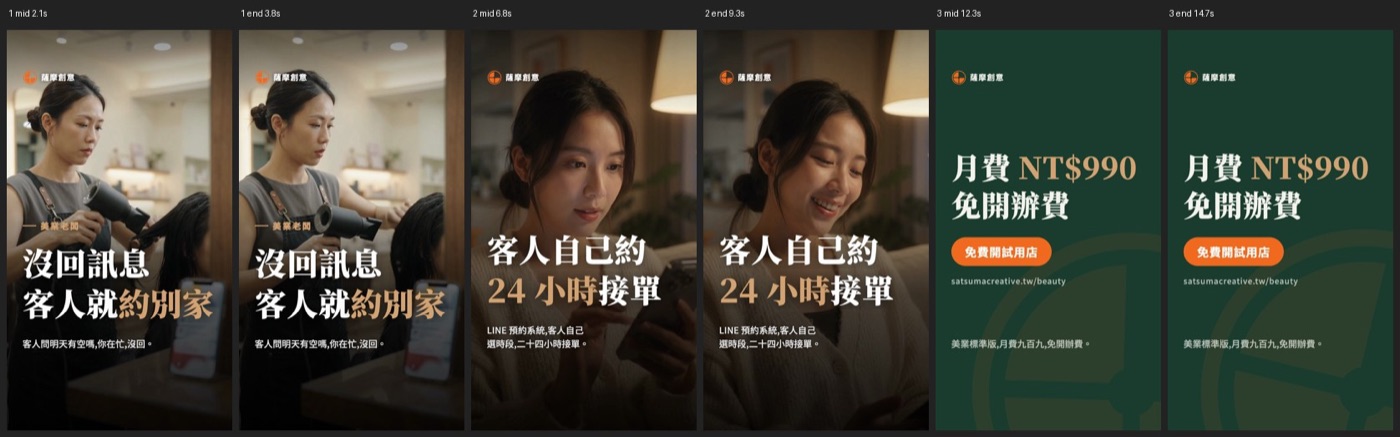
- Hook: A customer asks if you're free tomorrow. You're busy and don't reply. (A stylist blow-drying hair while a phone lights up on the counter)
- Selling point: Customers pick their own time slot, bookings taken 24 hours a day. (A customer on the sofa at night tapping their phone, smiling once it's booked)
- Close: Beauty standard plan, NT$990 a month, no setup fee. (Brand end card)
The final cut runs 15.0 seconds, the audio hits social platform loudness standards, and all text sits within the safe zone (not covered by platform buttons or account names). These were measured by code.
But three things were done by a person, and every one of them mattered:
1. Checking the price.Before rendering, I checked "NT$990 a month, no setup fee, free trial" against the current wording on the live website. When AI writes a script, it writes what it knows; it doesn't know whether the price changed last week.
2. Text over a face.On the first composite, the large text landed right on the person's face. I'd tested many rounds on solid-color backgrounds without a problem, because solid backgrounds don't have faces. It only showed up with real footage. Fixed: text overlaid on video now always sits in the lower half.
3. A continuity error.In the stylist segment, the phone on the counter starts out lying flat, then a second later it's standing up and lit. This is an old AI video problem: it doesn't remember where things were a second ago.
The model caught none of these three.
How many words fit in 15 seconds
A number every scriptwriter needs to know: Chinese narration runs about 3 to 3.5 characters per second. Allowing for a pause at the start and holding the end card long enough to read,a 15-second ad caps narration at about 40 characters。
How much is 40 characters? In the original Chinese, this paragraph already passed 40 by this point.
So adreel has a check: if the script's narration is too long, it's blocked from moving on to voiceover. Better to cut while writing than to find out after recording that it runs 18 seconds.
August's reference-image trap: where it stands now
August's most counterintuitive finding: give AI a character photo as reference, and it copies the background and composition too — all three scenes turned into the gray studio backdrop of the costume test shot. What finally worked was describing the character's appearance in text.
This time, Google's Omni splits "reference images" into two uses:
- As the first frame: the video starts moving from this image
- As reference only: it takes how the person and clothing look from the image, but generates the scene from the prompt
The second is exactly what I wanted in August and didn't have. I tested it with photos of a school uniform. Results:
| Result | |
|---|---|
| Clothing style and colors | ✅ Holds up |
| Text on clothing | ❌ Gets distorted — the school's initials turned into other letters |
| Faces | ⚠️ Only "looks similar," not "the same person" |
The model has improved, but in a very typical way:the big things are right, the details still aren't. If your product's key detail is the lettering on the clothes, you still can't hand it over.
The same night I hit a snag that had nothing to do with the model. I uploaded three images, assumed they'd animate once I hit the button, and all three segments came out as still frames. The reason: at the time, "upload an image" and "generate video from this image" were two separate actions on the page, but the interface didn't say so. If I misread a tool I wrote myself, others definitely will. Now the screen states it plainly: upload without generating, and it stays still.
August's lock has grown into a whole row of checkpoints
The thing I was proudest of in the August post was the "two-stage lock": until the storyboard is final, the generate-video button won't work, because the two steps differ in cost by 40x.
This production line pushes the same idea to every station:
- No approval, no voiceover — the code refuses.Change a single character after approval and it needs re-approval
- Every step that costs money quotes first, then stops.Generation only starts once someone says yes
- Accounting in "coins."Each paid action deducts coins up front and refunds automatically on failure. 1 coin is roughly NT$1 of our cost
Coins look like game design, but they're really a continuation of August's "cost ledger": platforms only tell you how much credit you have left, not "how much this ad cost." With coins, every ad gets its own ledger, and you can set a cap in advance.
Same line as in August:A tool's most valuable feature is often what it won't let you do.
If all you can do is reroll, roll three at a time
The third problem in the August post had no solution: AI video has no "fine-tuning," only "regenerate the whole thing."
That limitation still holds in November. But I came at it from another angle:Since every attempt is a reroll anyway, roll three at once and let a person pick.
Choosing is far easier than describing. Asking someone to say "what kind of music I want" is hard; play them three tracks and they know instantly which one.
So adreel became a "production meeting" interface: the user sits in the producer's chair, and every department — writer, director, voice, music, casting, art, wardrobe, camera, color grading, titles, editing — submits three versions. Every item needs the producer's sign-off; if you don't like one, send it back with a one-line note.

The point of this interface isn't cuteness (though I admit the little figures are cute). It'stranslating a chain of technical steps into roles people already understand. Someone who doesn't know what a "prompt" is still understands "the director pitched three ways to shoot it, and I want the second."
What I ran into building the tool
This section gets technical; feel free to skip it.
1. A temp file ballooned to 140GB.During testing, the mixing step suddenly ran away and wrote a temporary audio file up to 140GB, filling the entire drive for about 4 minutes. The cause: I'd handed an "infinitely looping" music track to the media processing tool to mix with the narration, and roughly one time in twenty it would fail, and when it did, it never stopped. The fix was to read each sound into its own length-capped file first, then layer them in my own code.
Any "infinite" input needs a cap on its output. A time limit and a file size limit — add both.
2. AI can't hear music.Music selection was originally "whatever the search returns." For an upbeat ad, the candidates included "sad drama" and "medieval guitar." I changed it to search 40 tracks first and have the model pick three from their titles and tags. Much better, but the model is choosing tags, not sound.The final check still takes a person with headphones on.
3. AI occasionally ignores the format.The scripting step asks the model to reply in a fixed format. Most of the time it complies, but occasionally it replies with something irrelevant. The code needs to be ready: if the format is wrong, ask again automatically; if it's still wrong, refund the coins and tell the user.
4. Prepaid error messages.Google's video generation is prepaid, then deducted. When the balance runs out, what comes back is a string of English error codes that looks like the program is broken. I changed it to plain language: "Video generation credit has run out."
What still can't be done
As in August, after the upsides come the limits.
- You can only reshoot a whole segment, not fix a few frames.A continuity error like the phone going from flat to upright means either regenerating the whole segment or living with it. August's "no seed" problem is still true today
- Real product screens still can't be generated.In the LINE booking ad, I deliberately kept the phone screen blurred. To show the actual booking interface, you need a real screenshot added separately. In August I said "there's no way around this," and that still holds
- Faces aren't the same person.Reference mode gives you "similar." Getting the same actor to appear reliably across three segments isn't possible yet
- Making an ad doesn't mean it sells.I haven't run this ad yet. Video quality and ad performance are two different things; the latter needs to be measured separately
So how much has the distance shrunk
| August | November | |
|---|---|---|
| One 15-second ad | A full day, NT$92 (NT$42 of it on assets) | Under 10 minutes from approval to final cut, about NT$36 |
| Cost per second of video | About NT$1.4 | About NT$3 (the price of dropping Chinese engines) |
| Text cards, music, timing | All manual | Handled by code |
| What gets delivered | Raw assets | A final cut ready to upload |
| No fine-tuning, can't generate real interfaces | Yes | Still yes |
In August I called it an asset factory. In November,at the 15-second ad scale, it can now be a finished-film production line.
But look back at every key moment in this post: checking the price, spotting text over a face, catching the phone continuity error, hearing that the music was wrong, deciding whether this ad is worth running.None of them were done by AI.
Over these three and a half months, what AI shortened wasthe distance of doing. What used to take a full day of editing, typing text cards, finding music, and syncing timing now takes minutes.
The distance of judgment hasn't shrunk.It's just been pushed somewhere more visible: before, your time went into doing, with judgment mixed in; now doing takes no time, and what's left is almost entirely judgment.
That's probably the most realistic picture of AI tools: they won't decide for you, but they give youtimeto decide.